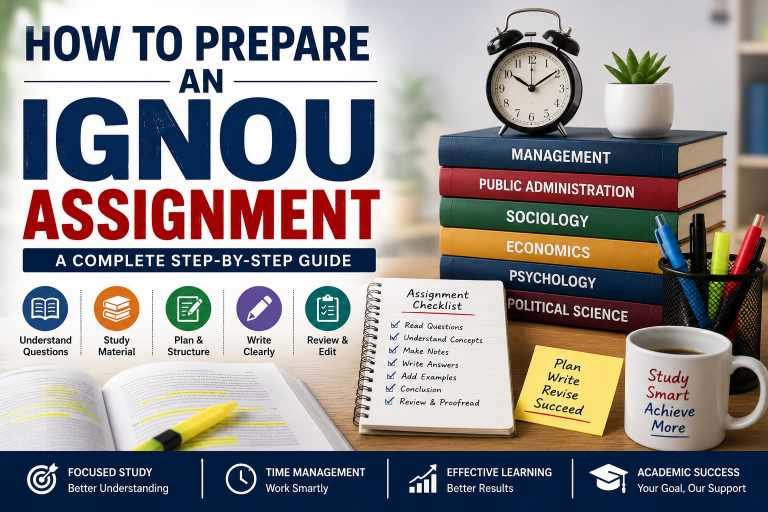
How to Prepare an IGNOU Assignment: A Complete Step-by-Step Guide
Preparing an IGNOU assignment may seem confusing, especially when you are a new student. You may have questions such as: Which assignment should I download? How should I write the answers? How many words should I write? Where do I have to submit the assignment?
Do not worry. This guide explains the complete IGNOU assignment process step by step in simple language, so you can prepare and submit your assignment correctly.
1. Check Your Programme and Course Code
Before downloading or writing an assignment, first check your Programme Code and Course Code.
For example, if you are studying MSO, you may have courses such as MSO-001, MSO-002, etc. You need to make sure that you are using the assignment for the exact course you are studying.
Do not select an assignment only because the subject name looks similar. Always match the course code.
2. Download the Correct Assignment Question Paper
The next step is to get the latest applicable assignment question paper for your course.
Before you start writing, check:
- Programme Code
- Course Code
- Assignment Code, if mentioned
- Applicable session
- Questions
- Marks
- Word limit
- Special instructions
Do not depend on an old assignment just because the course code is the same. The questions may change from one session to another.
3. Read the Complete Assignment Carefully
Once you have the assignment paper, read all the instructions carefully.
For example, the assignment may say:
“Answer the following questions in about 500 words.”
or
“Answer any five questions.”
These instructions are important. You should know how many questions you have to answer and approximately how long each answer should be before you start writing.
4. Understand the Question Before Writing
Do not start writing as soon as you see the question. First understand what the question is asking.
For example:
Explain means you need to make the topic clear with proper details.
Discuss means you need to explain the topic in a broader and organised manner.
Analyse means you need to examine different aspects of the topic.
Compare means you need to explain the similarities and differences.
Critically examine means you should discuss the topic as well as its strengths, limitations or different viewpoints.
Understanding the question helps you write the right answer instead of writing unrelated information.
5. Read the IGNOU Study Material
Your IGNOU Study Material should be your main source for preparing the assignment.
First find the unit related to the question and read it carefully. Try to understand the concept instead of simply memorising it.
You can also use standard textbooks, research articles, government reports and other reliable sources when necessary. However, your answer should remain connected to the prescribed IGNOU course material.
6. Prepare the Answer in a Proper Structure
A well-written IGNOU answer should have a simple and logical structure.
Introduction
Start by briefly introducing the topic. Explain what the topic means and why it is important.
Main Body
This is the main part of your answer. Explain the important concepts, arguments, features, causes, effects, theories, examples or other relevant points according to the question.
Use headings and subheadings when they make the answer easier to understand.
Conclusion
At the end, write a short conclusion that summarises the main idea of your answer.
This structure makes your answer clear, organised and easy to read.
7. Follow the Word Limit
Always pay attention to the word limit given in the assignment.
For example, if the question asks for an answer of about 500 words, do not submit only 100–150 words. At the same time, you should not write 1,500 words simply to make the assignment longer.
The aim should be to provide a complete and relevant answer within the required length.
8. Write the Answer in Your Own Words
One of the most important things students should remember is to write in their own words.
You can read the IGNOU study material and other sources to understand the topic. But avoid copying complete paragraphs from websites, books or someone else’s assignment.
First understand the topic and then explain it naturally in your own language.
This makes your answer easier to understand and shows that you have actually studied the topic.
9. Use Headings and Subheadings
Large blocks of text can make an answer difficult to read. Use suitable headings whenever the answer has different sections.
For example, an answer on rural development might contain:
Meaning of Rural Development
Objectives of Rural Development
Role of Panchayati Raj Institutions
Major Challenges
Conclusion
Good headings help the examiner quickly understand the structure of your answer.
10. Add Examples, Tables or Diagrams Where Useful
Some answers can be explained better with examples, tables, flowcharts or diagrams.
For example, subjects such as Economics, Management, Geography, Environmental Studies, Science and Statistics may sometimes benefit from visual presentation.
However, do not add diagrams or tables just to increase the number of pages. Use them only when they help explain the topic clearly.
11. Keep Your Handwriting Neat
If you are preparing a handwritten assignment, make sure that your handwriting is clear and easy to read.
Write the question number properly before every answer. Maintain reasonable spacing between paragraphs and headings.
Your assignment does not need fancy decoration. What matters most is clean, readable and organised presentation.
12. Fill in Your Student Details Correctly
Before submitting the assignment, carefully fill in the required student information.
This may include:
Student Name
Enrolment Number
Programme Code
Course Code
Course Title
Assignment Code
Study Centre
Regional Centre
Date of Submission
Be especially careful while entering your Enrolment Number and Course Code. Check them twice before submitting.
13. Check That All Required Questions Are Answered
After completing the assignment, compare your answers with the original question paper.
Make sure that:
No required question is missing.
Question numbers are correct.
Answers match the questions.
You have followed the required choice, where the assignment asks you to answer a specific number of questions.
This simple check can help you avoid unnecessary mistakes.
14. Proofread Your Assignment
Before submission, read the complete assignment one more time.
Look for spelling mistakes, incomplete sentences, missing pages, incorrect question numbers and incorrect student details.
Also check whether the answers are relevant to the questions and whether the word limit has been reasonably followed.
15. Submit the Assignment Through the Correct Method
Once your assignment is complete, you need to submit it using the current submission method applicable to your programme and centre.
Depending on the applicable instructions, submission may involve an online system or a physical submission through the concerned Study Centre or Regional Centre.
Always check the latest official instructions before submitting because procedures can change.
16. Keep Your Submission Proof Safe
This is a step that students should never ignore.
After submitting your assignment, keep the submission receipt, acknowledgement, confirmation, screenshot or other proof of submission safely.
Do not delete it immediately. Keep it until your assignment submission and marks/status have been properly updated.
Common IGNOU Assignment Mistakes to Avoid
Many students make simple mistakes that can easily be avoided. Some common mistakes include using the wrong assignment session, selecting the wrong course code, answering the wrong questions, ignoring the word limit, copying content without understanding it, entering incorrect enrolment details, submitting incomplete assignments, or failing to keep proof of submission.
Another mistake is writing a very long answer without actually answering the question. Always remember: a relevant, well-structured answer is better than a unnecessarily long answer.
Final IGNOU Assignment Checklist
Before submission, check everything once:
✓ Correct Programme Code
✓ Correct Course Code
✓ Correct Assignment Question Paper
✓ Correct applicable session
✓ All required questions answered
✓ Word limit followed reasonably
✓ Answers written in your own words
✓ Proper headings and presentation
✓ Correct student details
✓ Correct submission method
✓ Submission proof saved
Conclusion
Preparing an IGNOU assignment is not difficult when you follow the correct steps. Start by checking your programme and course code, download the correct assignment question paper, read the instructions carefully and prepare your answers using the IGNOU study material.
Write each answer in a clear, organised and student-friendly manner. Use an introduction, main discussion and conclusion where appropriate, follow the word limit, and keep your presentation neat.
Finally, submit the assignment through the currently applicable official submission process and always keep your submission proof safe.
The most important thing to remember is simple: use the correct assignment, answer the exact questions asked, write in your own words, and follow IGNOU’s instructions carefully.